
Stay connected. Join our list
The realization of an ambitious and entirely unique vision, 1996’s Chihuly Over Venice was the artist’s tribute to the city that had shaped and inspired him as a young Fulbright fellow nearly 30 years earlier.
Given its scale, novelty, and visibility, Chihuly Over Venice quickly made waves in the contemporary art world, inspiring documentaries, articles, and essays. One such essay is from Tina Oldknow, the former curator of modern glass at Corning Museum of Glass, who took a deep dive into the story of Venice as an ancient hub for glassblowing and Chihuly’s place within its modern history. Below is excerpted her 1996 “Chihuly Over Venice: Dale Chihuly’s Shining Legacy.”
You can read the full essay here.
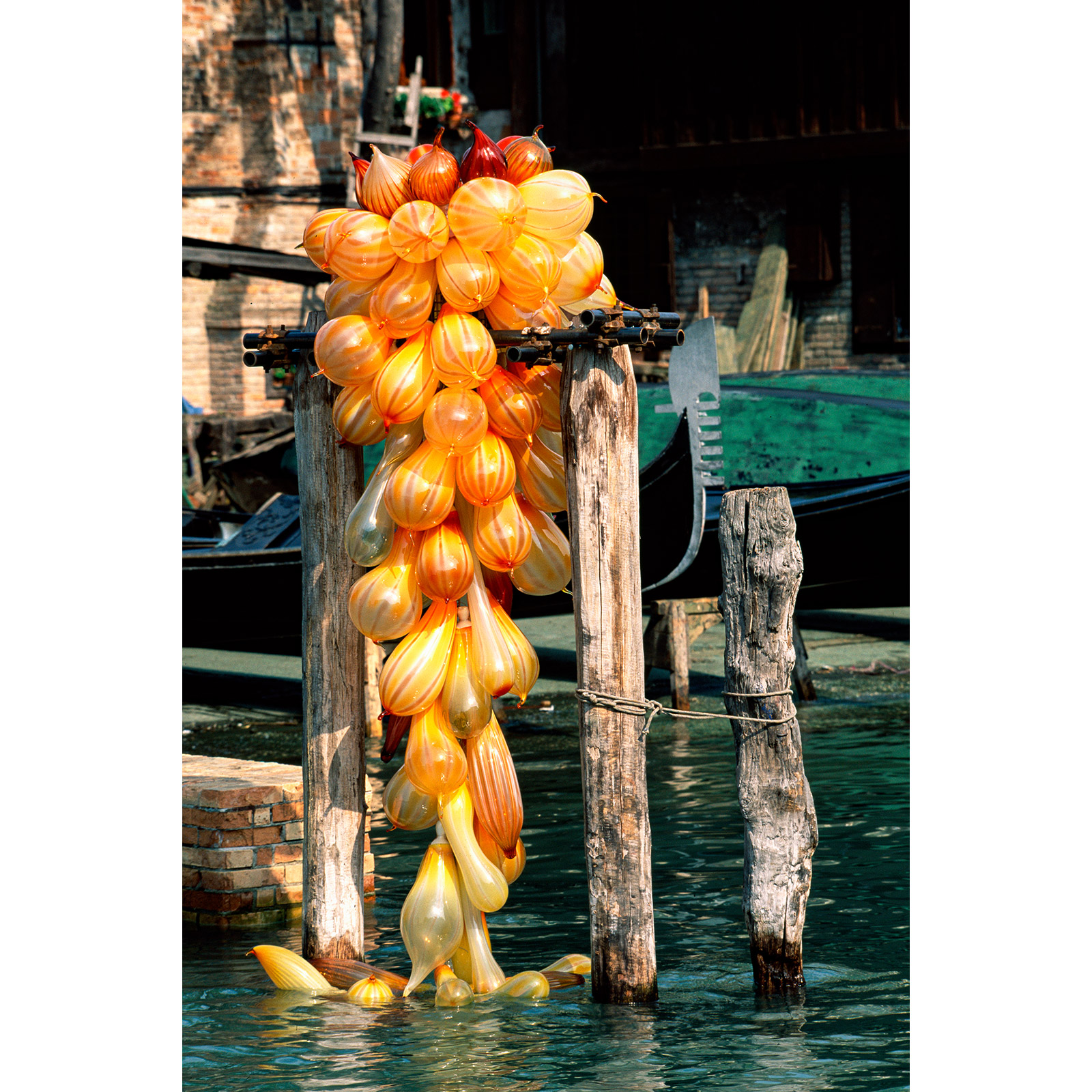
Squero di San Trovaso Chandelier, 1996, 10 x 4', Venice
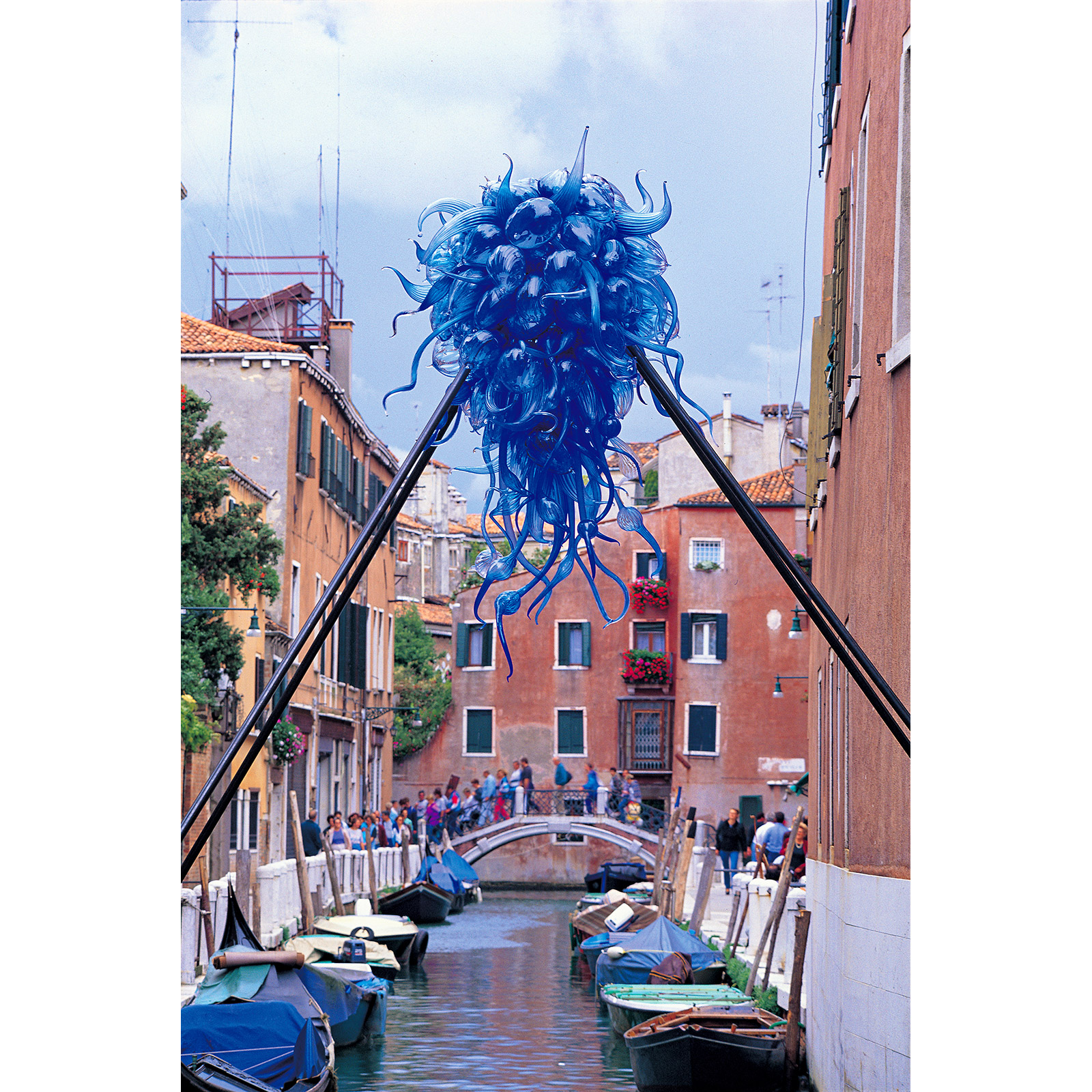
Rio delle Torreselle Chandelier, 1996, 7 x 8', Venice
In September 1996, Dale Chihuly successfully concluded his monumental project, Chihuly Over Venice, with the installation of fourteen immense glass Chandeliers throughout the fabled city of Venice. Some Chandeliers were placed in architectural spaces, but the majority appeared in and around Venice’s celebrated canals. Composed of hundreds of organically shaped elements, ranging from elaborate curls, to cones, to spheres, the brilliantly colored and crystal-clear Chandeliers were supported on metal structures that enabled the heavy and massive works to be installed at a variety of sites such as outdoor gardens, terraces, bridges, loggias, courtyards, over cisterns, and indoor locations. Some Chandeliers, freed from their supports, floated in water. Shining by day throughout the city, the Chandeliers came alive at night, emanating light from within to become fantastic and magical apparitions, glowing with the evanescent beauty and heroic pathos that is the hallmark of Chihuly’s art.
Chihuly Over Venice is, first and above all, a highly important project and major artistic statement by a mature contemporary artist that will undoubtedly remain as one of the highlights of a remarkable and prolific career. But Chihuly Over Venice is also a meaningful tribute to the medium of glass, to its history and development in Venice, and to its future as a material capable of as great a scale, complexity, and significance for sculpture as it has become for architecture.
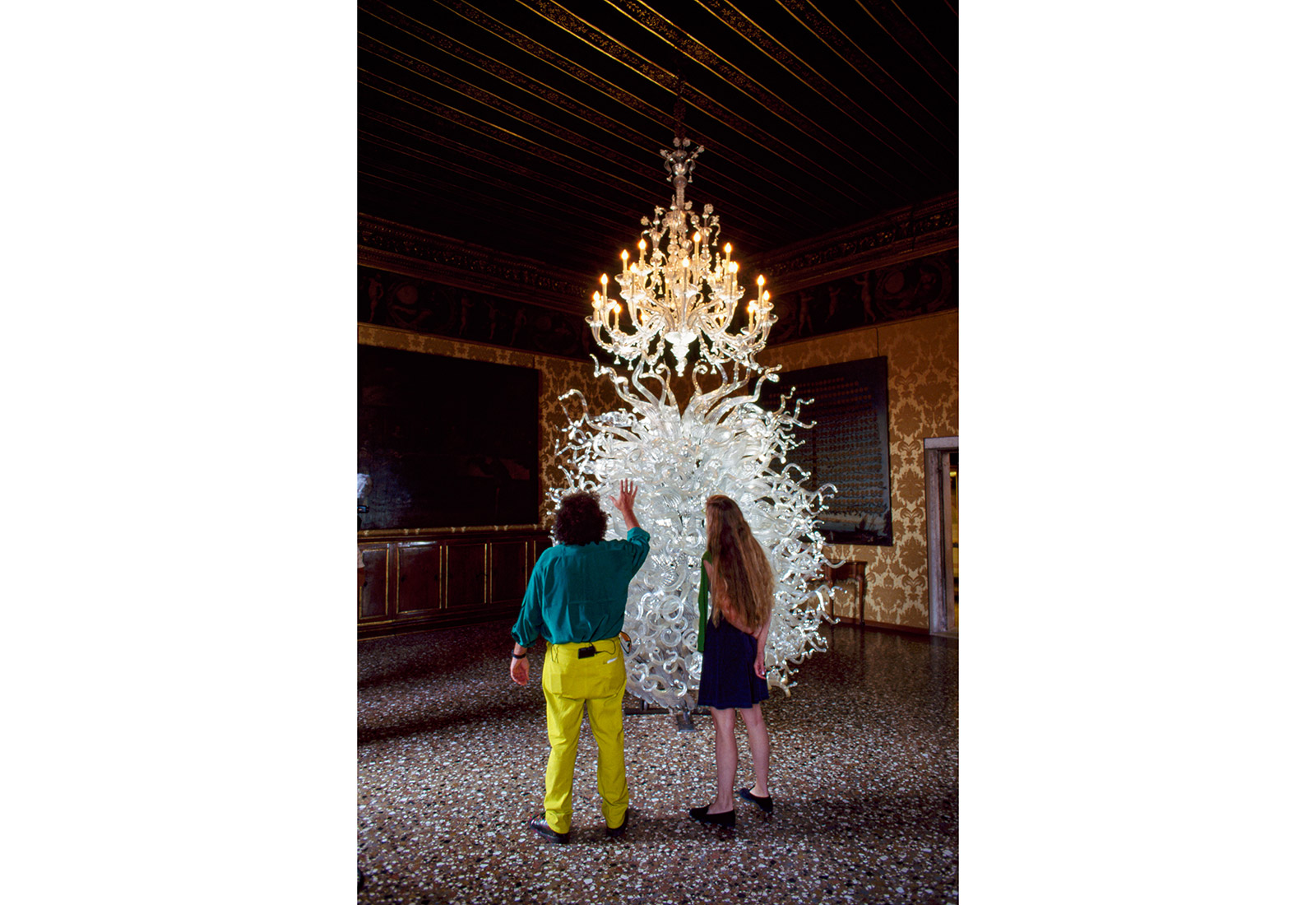
Chihuly and Leslie Jackson with Palazzo Ducale Chandelier, Venice, 1996
In September 1996, the Venezia Aperto Vetro, the first international biennial for contemporary art in glass, was held at the Palazzo Ducale and the Museo Correr in the San Marco quarter of the city of Venice, and at the Museo Vetrario on the nearby islands of Murano. Venice was particularly well-suited as a site for this inaugural event, not only for its obvious connection as "the spiritual home" or even "Mecca" of glass, but for its tradition of hosting one of the most prestigious expositions in the world of contemporary art: the Venice Biennale. The choice of the Palazzo Ducale to showcase the work of an international group of recognized glass artists was particularly appropriate since "dazzling exhibitions of the treasures and skills of Venetian industry and craftsmanship" were traditionally held in the halls and galleries of the Palazzo on state occasions.
Curated by British glass historian and art critic, Dan Klein, with Venetian historian and museum administrator, Attila Dorigato, and advised by an international committee of 15 arts professionals, the Venezia Aperto Vetro included artwork by over 100 international artists working in glass, with vessels, sculpture and installations by 26 “masters,” including Dale Chihuly, whose work for the Aperto tied in to his own monumental project, Chihuly Over Venice.
The challenge of blowing glass on water is evidently a Venetian favorite. When Henry III of France visited Venice in 1574, his royal gondolas were escorted by an armada of decorated boats, including 14 galleys with glassblowers fashioning objects for the king’s amusement out of the mouths of furnaces in the shape of marine monsters. Passing through triumphal arches specially erected for his visit (designed by the famous Renaissance architect Andrea Palladio and painted by the equally famous Renaissance artists Jacopo Tintoretto and Paolo Veronese), the French king and his retinue entered the Ca’ Foscari on the Grand Canal, decorated with yards of gold cloth and Venetian velvets, where a state dinner for 3,000 people was served. The Venetian women wore only white and they were covered with pearls. “The king, a simple soul, was apparently never the same after that experience,” tells Jan Morris. And rumor had it that the unfortunate monarch, from that time on, lived “in a perpetual daze.”
Although elements of the Chihuly Over Venice project may bring to mind such eccentric historical precedents as these, there has never been anything like Chihuly Over Venice in the craft-associated media to which glass belongs. Chihuly’s singular mixture of ambition, enchantment, heroic scale, and spectacle comes closest to works by contemporary Land artists, such as Christo, whose projects not only involve the temporary transformation of architecture and landscape, but engage the diverse group of people participating in the process (for example, artists and fabricators, builders, landowners, city officials) as well as witnesses of the project (media and other members of the public) in the artistic activity/performance.
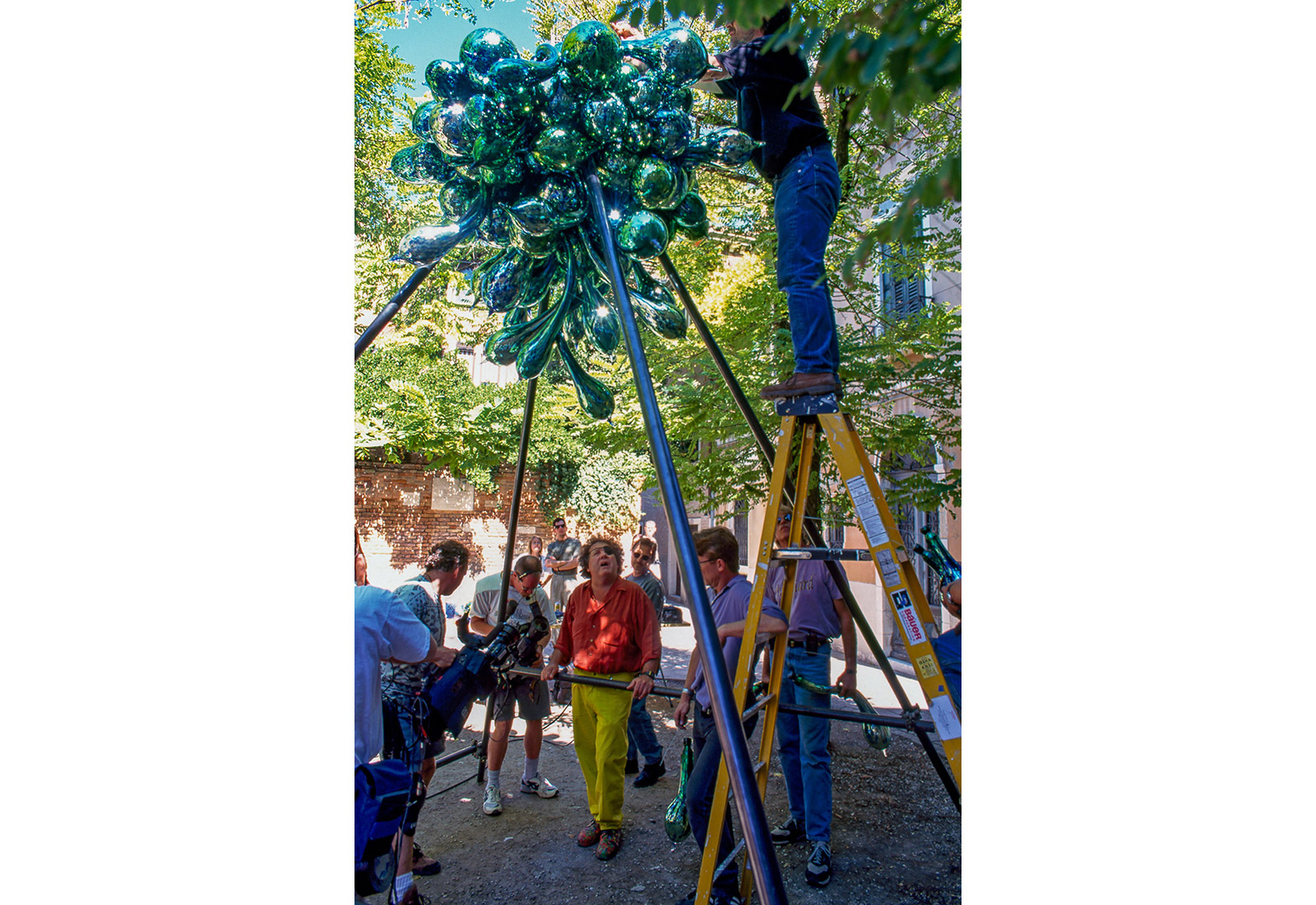
Chihuly, Tom Lind, Parks Anderson, and team members working on Campiello Barbaro Chandelier, Venice, 1996
Chihuly Over Venice was conceived as a site-specific project, that is, it was made for Venice and could not ultimately have been realized anywhere else. Chihuly’s initial vision saw Chandeliers hanging over the city’s Grand Canal and he could have focused Chihuly Over Venice exclusively on Venice, undergoing all his preparations in the U.S. and Italy. But the artist chose to enrich the texture of the entire process by involving people from additional sites and cultures with significant glass traditions. For this, too, Chihuly might have stayed in Europe: England, France, The Netherlands, Germany, Spain, and the Czech Republic (Bohemia) all have long histories of glassmaking. But he selected locales a little off the beaten track and more geographically varied: the Iittala Glassworks in Nuutajärvi, Finland, where Chihuly and a team of 30 people (including glass artists, installers, organizers, and photographers and other documenters) occupied the tiny village for the month of June in 1995; the Waterford Crystal Factory in Butlerstown, Ireland, where Chihuly’s team worked with Waterford glassblowers and master engravers for ten days in September, 1995; and Vitro Crisa in the large, industrial city of Monterrey, Mexico in January, 1996 where Seattle glass artists worked with commercial bottle blowers accustomed to production lines.
Glassmaking shares ancient techniques that transcend language barriers, yet every place had a distinctively different approach to glass that Chihuly realized would make the project, and the Chandeliers themselves, more exciting and energetic.
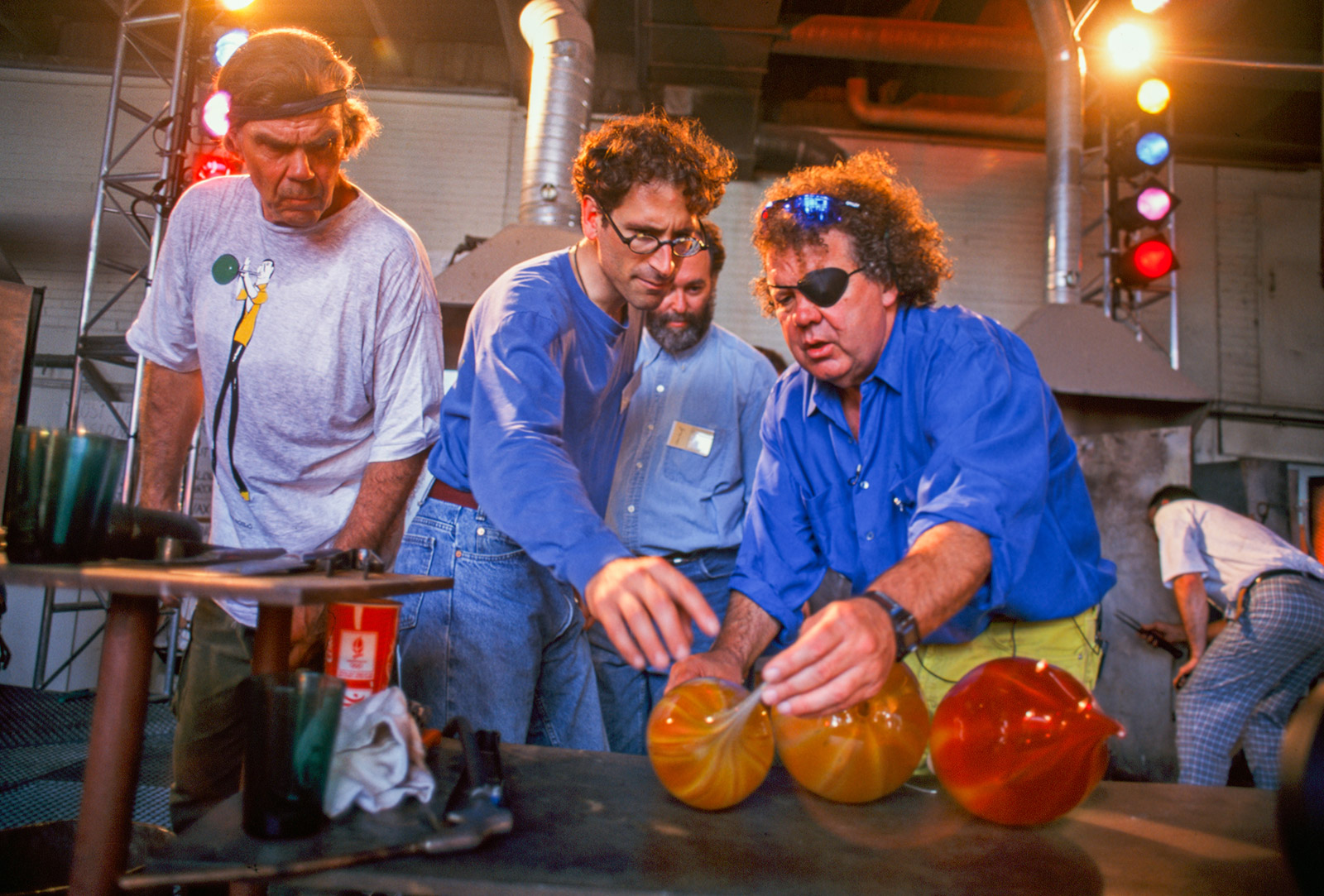
Unto Suominen, Joseph Rossano, hotshop team member, and Chihuly, Nuutajärvi, Finland, 1995
Tina Oldknow is an independent curator and art historian specializing in contemporary art, craft and design in glass. The former Senior Curator of Modern and Contemporary Glass at The Corning Museum of Glass in Corning, New York, she has curated over 30 exhibitions and has written over 100 books, articles and essays on glass. She holds a BA in art history from the University of California, Los Angeles, and an MA in art history from the University of Pennsylvania. In 2014, she was named an Honorary Fellow of the American Craft Council, and, in 2015, she was appointed Honorary Fellow of The Corning Museum of Glass.