Stay connected. Join our list
The first major Chihuly garden exhibition in Australia and in the Southern Hemisphere, Chihuly in the Botanic Garden is breaking not just geographic barriers, but also attendance records. Hitting the one million visitor benchmark with more than a month to go, Chihuly in the Botanic Garden has been a watershed moment for the art community in South Australia.
With the exhibition closing on April 29, Director of the Botanic Gardens and State Herbarium of South Australia Michael Harvey, and CEO of JamFactory Brian Parkes shared their thoughts about the exhibition and how it connects to Chihuly’s early work in Australia.
Chihuly Studio: Chihuly in the Botanic Garden is not South Australia’s first encounter with glass in fine art. Can you tell us a little more about Adelaide’s connection to the Studio Glass movement?
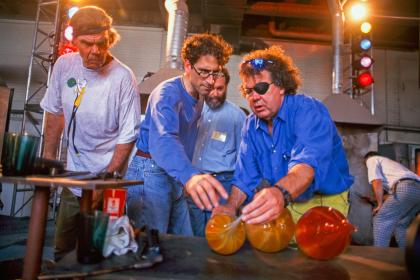
Brian Parkes: Adelaide has been a hub for the Studio Glass movement for over 50 years, starting with the first hot glass studio at JamFactory, established in 1974 by founding Studio Head and Harvey Littleton student Sam Herman. JamFactory’s Glass Studio has since attracted and contributed to the training and career development of more than 150 glass artists from around the world.
South Australia remains one of only three locations in Australia where glass can be studied formally at a tertiary level. The first glass program was initiated by artist and Chihuly student Stephen Skillitzi at the South Australian School of Art in 1976. Four years later, artists Gerry King and Abraham Fynnaart set up a separate program at the South Australian College of Advanced Education. Eventually, the two programs merged within the University of South Australia. This program has launched the careers of many prominent artists and is now led by acclaimed artist and JamFactory alumnus Gabriella Bisetto.
CS: While this is Chihuly’s first major garden exhibition in the Southern Hemisphere, he has presented work in Australia in 1999–2000. Have any guests shared memories of those smaller early exhibitions?
BP: The 1999 exhibition Chihuly: Masterworks in Glass at the National Gallery of Australia in Canberra has been fondly mentioned by many visitors.
One of Adelaide’s most dynamic and accomplished younger glass artists is Liam Fleming. Liam’s passion for glass was first ignited in 1999 when, as a boy travelling with his family, he visited that Chihuly exhibition at the National Gallery. So captivated was he that, at the age of 16, he began learning glassblowing in a private Adelaide studio, studied at the University of South Australia, and later completed the JamFactory training program.
A scaled-down version of Chihuly: Masterworks in Glass was presented at JamFactory in Adelaide in 2000 in conjunction with the Adelaide Festival of Arts. Many locals have shared stories of seeing this show, which remains one of JamFactory’s most successful ever—and the fixing points that were installed to hold some of the suspended works remain in the ceiling today!
CS: The exhibition is open alongside some other wonderful arts and culture moments in Adelaide like the Fringe Festival. How has all this energy impacted the community? What was it like to hit that 1 million visit count?
Michael Harvey: The energy around the gardens this summer has been extraordinary. Having the exhibition here for seven months has meant that it has accompanied the different seasonal moods of the garden, and of our city. It has coincided with major arts festivals and sporting events, and we have really seen that cross-pollination of diverse audiences with the different events across the summer. As a free-entry site during the daytime, people are able to come and go throughout the day and I am sure many locals are coming to see the exhibition and the garden again and again.
Getting to our “stretch” target of a million visits with still six weeks to run in our program was a real thrill—and with over 10% of these visitors coming to our special Chihuly Nights experience, audiences are getting to see the garden in a completely new context. The night program has proved so popular that we have had to increase our capacity multiple times, adding more nights per week and welcoming more visitors each night. All this has had a great effect on our relationship with the broader cultural life of the city and we are certainly seeing local café and restaurant businesses benefiting from the increase in activity around the gardens—day and night. I know Adelaide will remember Chihuly in the Botanic Garden for a long time.
CS: Obviously, there are major logistical hurdles in shipping and installing a major exhibition made of thousands of pieces of glass across the ocean, but did any part of that process surprise you—for better or for worse?
MH: While we always knew this would be a complex project, I guess the sheer depth of planning and problem-solving required for every aspect of the project was still somehow a surprise!
The project really emphasized the power of teamwork. The relationships built up over video conference calls—and then in person—between the Adelaide and Seattle teams was massively important in planning and delivery. We had extraordinary project managers leading each team, and each new challenge was met with a highly collegiate approach—whether it be customs and quarantine regulations, shipping schedules, truck quotas, or the final choreography of the installation program, bringing together foundations, armatures, glass, and horticulture.
It has also been great to hear (and indeed overhear) the many comments and questions that visitors ask us or each other as they speculate about how the works were made and how they could possibly have been transported. It is almost as if our teams have collaborated in an enormous magic trick that leaves people wondering how it was done.
CS: Chihuly was thrilled to design an installation specifically for the Palm House, and even more so to learn that it will be permanent in this beautiful space thanks to the generosity of Dr. Pamela Wall OAM. How do you see this fitting into the future of Adelaide Botanic Garden and Studio Glass in Australia?
MH: The site-specific nature of the work was a huge factor in our success in attracting the support from Dr. Wall to retain it permanently; it just worked so well in the space and complemented the building magnificently. We know that glass conservatories around the world have inspired Chihuly in the creation of his exhibitions, so having the Glacier Ice and Lapis Chandelier remain in our oldest conservatory is a beautiful reflection of that inspiration.
Like many botanic gardens around the world, public art is very much a part of our site. Bringing a new contemporary piece into our permanent collection not only adds a new dimension to our site, but it also emphasizes a medium that is very strongly represented in the South Australian art community.
CS: As you’ve mentioned, there’s a thriving glass scene in Adelaide. Do you see the exhibition influencing Studio Glass artists in Australia going forward?
BP: We certainly hope so! The extraordinary success and visibility of the exhibition has significantly raised awareness of glass as an expressive artistic medium. JamFactory is seeing increased interest in one-on-one intensive glassblowing classes and sales of work by local artists has continued to grow. Glass art enthusiasts have come from far and wide to see the Chihuly exhibition and as a result have discovered, or become better acquainted with, work by local glass artists—in turn expanding markets and creating new opportunities for Australian artists.
We hope the exhibition will see a whole new generation of artists fall in love with glass like Liam Fleming did in 1999, and that more established artists be emboldened to take risks and be ever more ambitious with their works and their aspirations.

Brian Parkes and Michael Harvey with Cattails and Copper Birch Reeds
Adelaide Botanic Gardens, Australia, 2024
Michael Harvey joined the Botanic Gardens and State Herbarium of South Australia as Director in 2021, bringing 20 years of experience in the museum, culture, and science sector to the role. His particular focus has been on the development of public experience in museums of science and natural history.
Michael has held leadership positions in the Australian Museum and the Australian National Maritime Museum in Sydney, and at the Natural History Museum in London. At the Botanic Gardens, Michael has overseen major capital works, a revitalisation of its public programming, significant growth in visitation, and changes to the organisation’s governance and planning.
Brian Parkes has been CEO at JamFactory in Adelaide since April 2010. He has overseen significant development of the organisation’s exhibition and training programs and substantial growth in its audience and operational budget. He is passionate about the social, cultural, and economic value of art, craft, and design and has worked in senior curatorial and commercial management roles in these sectors in Australia for over 30 years, including stints at the Australian Design Centre, the Museum of Contemporary Art, and the National Gallery of Australia. He has curated numerous exhibitions focused on contemporary Australian craft and design, and has remained active in mentoring and supporting emerging artists, designers, and creative entrepreneurs over the past two decades.